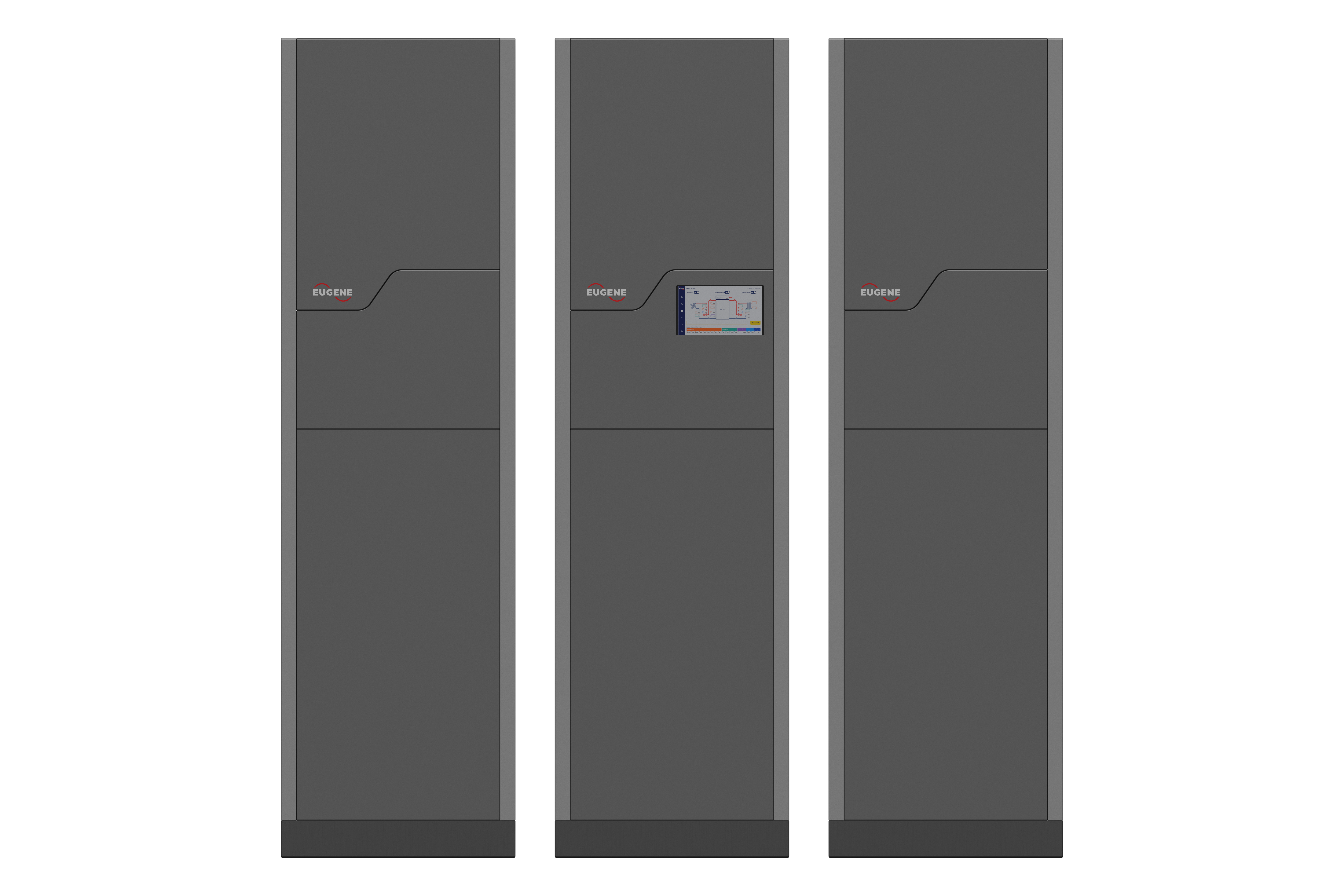
A compact distribution unit engineered for high-density computing, delivering high-efficiency heat exchange via the primary liquid loop.
Liquid-to-Liquid (L2L) CDU
- Introduction
- The Liquid-to-Liquid (L2L) CDU series offers a comprehensive range of standard capacities from 150kW to 2400kW. Designed with highly integrated piping and pump redundancy (single / N+N / N+1), the system fully supports automatic failover. Utilizing 25wt% Propylene Glycol (PG) as the secondary coolant, it serves as the critical infrastructure for data centers transitioning from traditional air cooling to advanced liquid cooling.
- Download
- Download the Eugene CDU Solutions Brochure (2026.05): Includes complete technical specifications and application guides for both L2L Liquid-to-Liquid (up to 2.4MW) and L2A Liquid-to-Air (mPUE 1.06) series.
High-Reliability Pumps & Intelligent Control: Features highly flexible pump architectures, offering N+N or N+1 high-reliability redundancy depending on the model
Compact & Flexible Space Utilization: Offers versatile spatial configurations. The 150 kW rack-mount model (LLR-0150) seamlessly adapts to existing cabinet integration, while standalone cabinet models can be equipped with heavy-duty casters and forklift handling at the base to facilitate flexible on-site deployment and transportation.
Ultimate Maintenance Convenience: Standalone cabinet models feature unique tilting and hydraulic lifting structures, providing maintenance personnel with ample operational space for filter replacement or internal servicing
Cooling Capacity Range: Covers capacities from 150kW to 2400kW.
Operating Temp & Coolant: The operating temperature range for the secondary coolant is 10°C to 55°C.
Power & Communication: Supports 400V, 50/60Hz three-phase power supply. Communication interfaces include RS485 RTU Modbus and TCP/IP SNMP for seamless integration.
- Ideal Environments: Perfectly suited for high-computing environments, including AI liquid-cooled computing pods, supercomputing facilities, and High-Performance Computing (HPC) centers.